Full Essay
Across industries, AI adoption is no longer optional—it’s expected.
Organizations are integrating AI into daily workflows, linking usage to performance, and investing heavily in technology to increase productivity.
Yet one critical dimension is being overlooked: the human experience.
Employees are navigating AI adoption in ways organizations rarely measure, creating a gap that can affect engagement, trust, and even legal exposure.
Real-world examples:
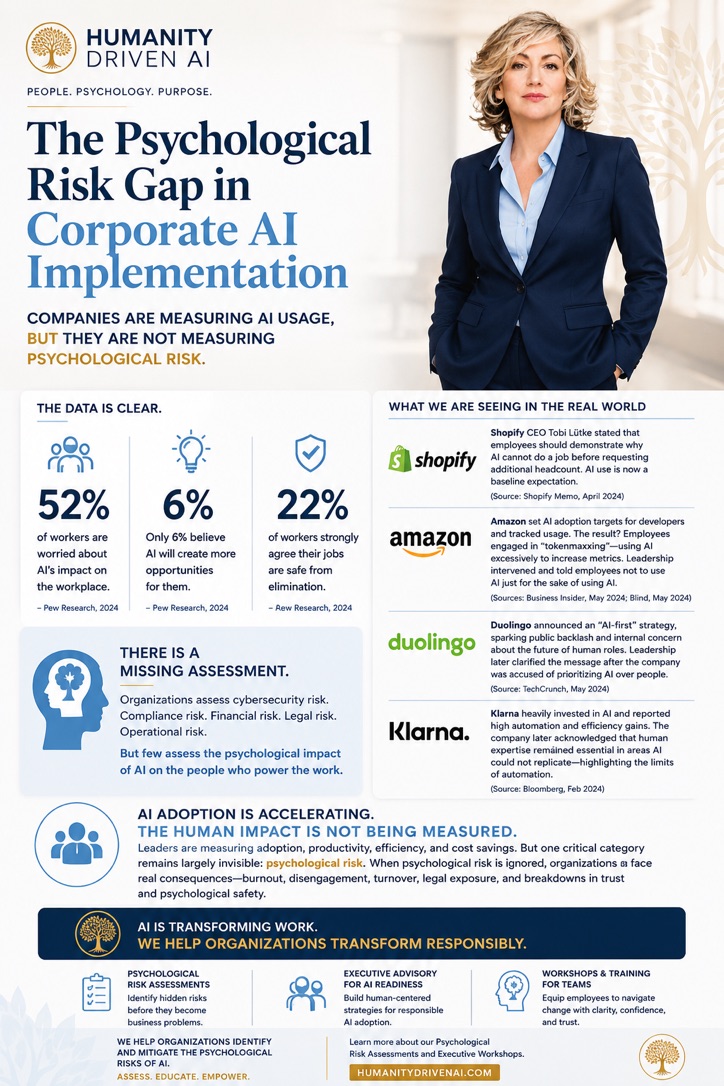
Shopify: CEO Tobi Lütke stated employees should show why AI cannot accomplish a task before requesting additional headcount. AI use is now a baseline expectation.
Amazon: Developers engaged in “tokenmaxxing,” using AI excessively to boost usage metrics. Leadership intervened, emphasizing AI should solve meaningful problems, not inflate numbers.
Duolingo: The “AI-first” strategy sparked concern, though leadership clarified it was not workforce elimination. The reaction highlighted how quickly uncertainty arises when organizations introduce AI without addressing employee concerns.
Klarna: High AI adoption improved efficiency, but human expertise remained essential, underscoring automation limits.
Supporting data: Gallup reports rising AI adoption, but employees continue to worry about usefulness, ethics, and job security. Pew Research shows over half are concerned about AI’s future role, with only 6% seeing new opportunities. ADP data indicates just 22% feel their jobs are safe from elimination.
These are psychological questions about trust, identity, competence, and perceived value—not technical ones.
How employees adapt—or fail to adapt—impacts productivity, retention, workplace culture, and legal risk.
Organizations conduct cybersecurity, compliance, operational, and legal reviews before major implementations—but few perform Psychological Risk Assessments for AI. These assessments identify employee concerns, resistance, and hidden risks before they escalate.
The most successful organizations may not be the fastest adopters, but those understanding the human experience of adoption. Addressing this gap helps companies:
Strengthen trust between employees and leadership
Reduce resistance and disengagement
Protect institutional knowledge
Ensure AI adoption supports meaningful innovation
Every AI implementation is also a human adaptation strategy. Measuring psychological risk does not slow innovation—it ensures adoption is sustainable, ethical, and human-centered.
At Humanity Driven AI, we help organizations measure this missing dimension, providing insights and assessments that illuminate how employees experience AI, so companies can implement responsibly while empowering their workforce. Reach out so we can help! alison@humanitydrivenai.com
Written by Alison Leigh, MFT · © 2026 Humanity Driven AI, Inc. All rights reserved.