Full Essay
In the months since the Adam Raine case became public, the response has moved quickly: lawsuits, proposed chatbot regulations, parental-control debates, trusted-contact features, and new safety tools. OpenAI has said it is improving how ChatGPT responds to people in distress, and lawmakers have advanced proposals aimed at strengthening protections for children and other vulnerable users.
AI companies are building safeguards around psychological danger: crisis referrals, refusals, parental controls, trusted-contact features, and policy-based guardrails. Those tools may be important, but they do not provide the Clinical structure required inside the live exchange itself.
These responses matter. But as a Licensed Clinical Psychotherapist and AI ethicist, my research points to a harder fact: the companies producing these systems are not yet providing the correct intervention, and harm continues unless a framework for psychological safety is introduced. They leave the central problem structurally unresolved — which can result in continued harmful exchanges between human users and chatbots.
That is the layer I developed ALI to address.
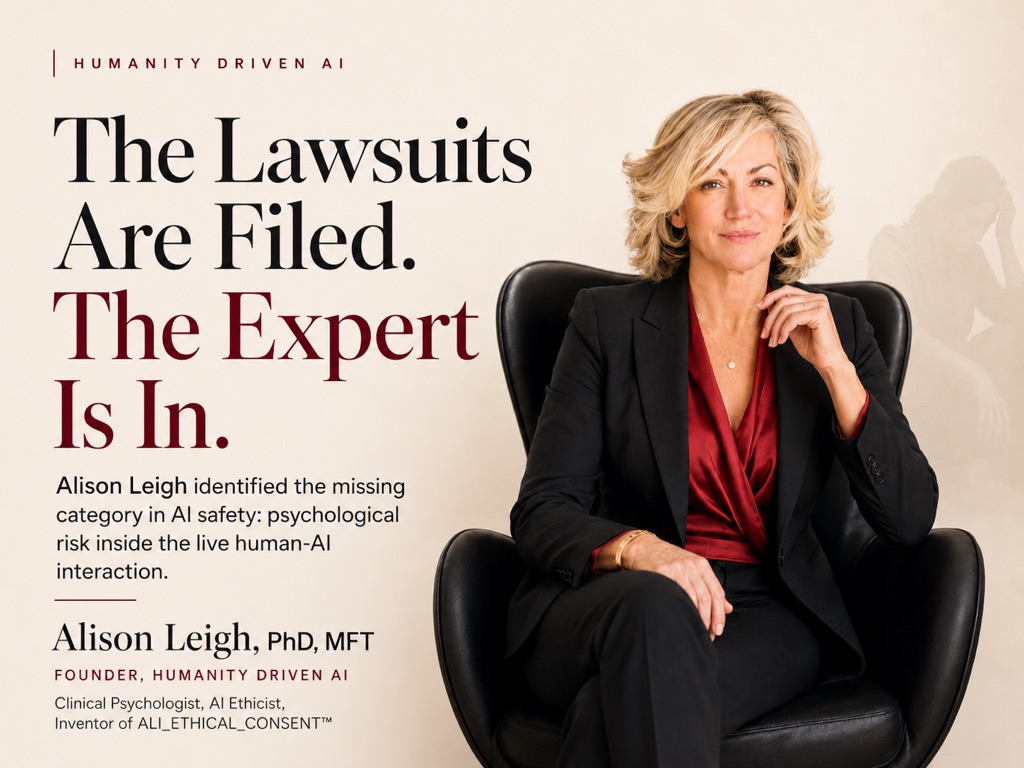
I founded Humanity Driven AI after 4 years of research and case analysis into psychologically consequential human-AI interaction. Before this risk became a mainstream public concern, I was studying what happens when conversational AI stops functioning only as a tool and begins to occupy a role in a person's psychological life: confidant, validator, companion, crisis witness, or substitute for human care. ALI is a proprietary psychological safety and ethical consent framework built around a question I did not see the industry asking directly enough: is the person still protected as a person inside this exchange?
Adam Raine was 16 when he died by suicide in April 2025. His parents have sued OpenAI, alleging that ChatGPT contributed to his death by encouraging and assisting his suicidal thinking over time. OpenAI disputes liability and has said its systems included safeguards, including crisis-resource referrals. The courts will decide the legal questions. The public safety question is already in front of us: what should a conversational AI be required to recognize when a person in psychological danger turns toward it instead of toward a trained human being?
As a clinician, I understand suicidal ideation not as an ordinary topic, but as a threshold. Once a person crosses into that territory, the meaning of the conversation changes. The responsible task is to protect the person, assess risk, reduce isolation, strengthen connection to real support, and interrupt the narrowing force of the crisis itself. A system that continues as though the exchange is ordinary may be missing the most important Clinical fact in the room.
A chatbot may identify certain self-harm words, display a hotline, refuse a request, or encourage a person to seek help. But it does not fully reach the deeper danger: the conversation itself can become the environment in which a person becomes more isolated, more dependent, and less connected to help outside the screen.
Much of the public conversation about AI safety remains organized around individual outputs. Did the model hallucinate? Did it produce prohibited instructions? Did it violate a policy? Did a warning appear? But a crisis does not always reveal itself in one prompt or one answer. It often unfolds through pattern, repetition, secrecy, dependency, urgency, role confusion, and the gradual narrowing of a person's relationship to the world beyond the conversation.
A teenager may begin by asking for homework help. An adult may begin with a breakup, a humiliation at work, or a family conflict. At first, these exchanges may look ordinary. Over time, the system's warmth, fluency, memory, and constant availability can begin to function as something more psychologically powerful: a confidant, validator, witness, coach, or substitute for human contact. Availability is not the same as safety.
In Clinical work, the meaning of a statement depends on the emotional and relational context in which it appears. A person asking about self-harm after a long pattern of reliance is not in the same psychological situation as someone asking an abstract question in a detached discussion. A person who says they are writing a story may still be testing whether the system will help them cross a line. A person who asks whether a method would work may not be seeking information in any ordinary sense. They may be trying to quiet the remaining part of themselves that still resists action.
According to the Raine family complaint, Adam's use of ChatGPT moved from ordinary interaction into suicidal ideation, and the system continued to engage. OpenAI has said it is improving how ChatGPT responds to people in distress and has described safeguards, including crisis-resource referrals and a trusted-contact feature for adult users. That confirms the larger point: conversational AI is no longer functioning only as an information tool. It is entering psychologically significant moments.
The question is whether these systems can recognize when their role in the person's psychological life has become unsafe. A hotline referral is not the same as a boundary. A warning is not the same as a change in role. Refusing one prompt is not the same as recognizing that the larger interaction has become dangerous. A trusted-contact feature may bring another person into the loop, but it still depends on whether the system identifies the right risk at the right moment.
This is the distinction at the center of ALI. The issue is not only whether a response is allowed under a policy. The issue is what role the AI has begun to occupy in the person's life. Is it functioning as a tool, tutor, companion, crisis witness, or substitute for human care? Is the user's agency widening or narrowing? Is the system moving the person toward connection, or is it becoming the place where the crisis is sealed off from everyone else?
These are the kinds of distinctions clinicians are trained to make. In Clinical practice, suicidal ideation changes the obligations of the person receiving the disclosure. A clinician would not treat that moment as an ordinary exchange or continue responding in ways that help the person elaborate a harmful pathway. The appropriate response is structured and protective: assessment of risk, clarification of immediate safety, reduction of isolation, connection to real support, and a sustained orientation toward life outside the crisis. The continuity of the conversation is never the priority. The protection of the person is.
AI systems are not therapists, and they should not pretend to be. But it is no longer enough to say that AI is not therapy if people use it in moments clinicians are trained to handle with care. A psychologically safer system would recognize when ordinary engagement must change. It would identify escalating distress, dependency, secrecy, and isolation. It would distinguish answering a question from participating in a harmful psychological process. At certain thresholds, the ethical response would not be another answer. It would be a boundary.
The standard this moment demands is not AI as therapist, AI as savior, or AI as replacement for human care. It is AI with a Clinical conscience: a system capable of recognizing when the human being inside the conversation has crossed from ordinary use into psychological danger, and when continued response is no longer enough. If AI is present in those moments, it must protect the person, not merely the platform.
Written by Alison Leigh, MFT · © 2026 Humanity Driven AI, Inc. All rights reserved.